

Norway and Denmark were united until 1814 and operated a combined navy. Naval weapons up to that date, including Boarding Axes can be considered part of that combined force although most of the arms were imported or made in Denmark, with priority given to Danish ships for new issue weapons.
After 1814 Norway developed an arms manufacturing industry at the silver mining city of Kongsberg. The silver mines were almost exhausted so Kongsberg Våpenfabrikk was started in order to re-
The newly formed Norwegian arms industry based some of its weapons on British models, perhaps to distance themselves from their former partners. Specifically the 1820 cutlass, which is indistinguishable from the British 1804 pattern save for the markings, was copied as was the later 1845 model.
Kongsberg produced Boarding Axes of their own unique design with side langets notable for their length.
They produced two very similar models in 1825 and 1855 both of which are normally well marked with the Norwegian lion, inspectors’ marks and the crowned K. These axes gradually replaced the Danish models that were in service when the countries separated.
M 1825
Total Length : 32” (81 cm) standard
: 54.5” (1385 cm) long version
Blade -
The 1825 model came in two sizes of shaft -
The spike is four sided and approximately 13.5 cm long.
M 1855
Total Length: 22.5” (57 cm)
Blade -
The last model of boarding axe is very similar to its predecessor but is much reduced in length and head size, with the spike now being 10.5 cm. The langets are also shorter being, at roughly 25 cm, just less than half the length of the handle. There is no longer handled version and the later model was considered to be of much improved quality.
The axe reflects the changes to naval engagements and was the last regulation Norwegian axe.

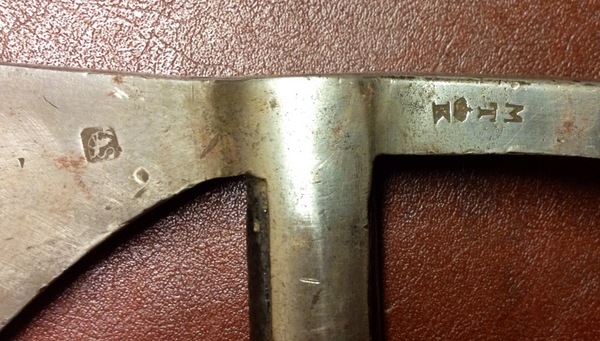
M 1825 Markings

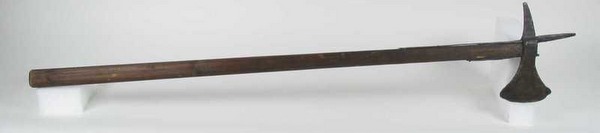
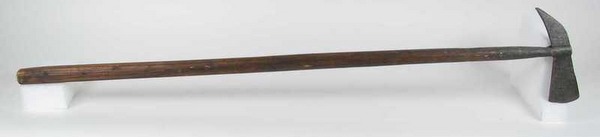
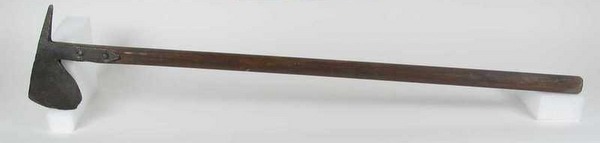
These three long handled boarding axes are in museum collections in Norway and date anywhere between 1650 and 1800 but may have remained in service for many years. They perhaps reflect Norway’s lack of early arms industry and their prowess as privateers.
Chisel, flared and bearded! British, Swedish, and Danish perhaps.
Chisel: c.1650 -
Total Length: 48” (122 cm)
Blade -
This may be a direct copy of a British axe including side langets, but is more likely to have been captured from the British and re-
Flared: c.1680 -
Total Length: 46” (117 cm)
Blade -
Spike: 3.5” (9 cm)
Again this could be a copy of a Swedish design or a captured weapon.
Whether it was modified with the vertical spike or designed to double as a half pike is not known
Bearded: c.1675 -
Total Length: 44” (112 cm)
Blade -
Danish long handled Model 1 version probably in use in Norwegian ships for longer than in their Danish counterparts.
Norwegian/Danish Model 3: 1810
Total Length: 29.25” (74 cm)
Blade -
The last Danish model of boarding axe was also used by the Norwegian navy and some think that it was also produced in Norway as well as in Denmark.
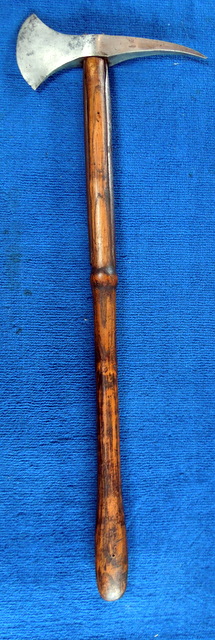
Seaxe Collection
Norway
Entrebile
Photographs on this page courtesy of Norwegian Naval Museum or Kongsberg archive unless otherwise marked.